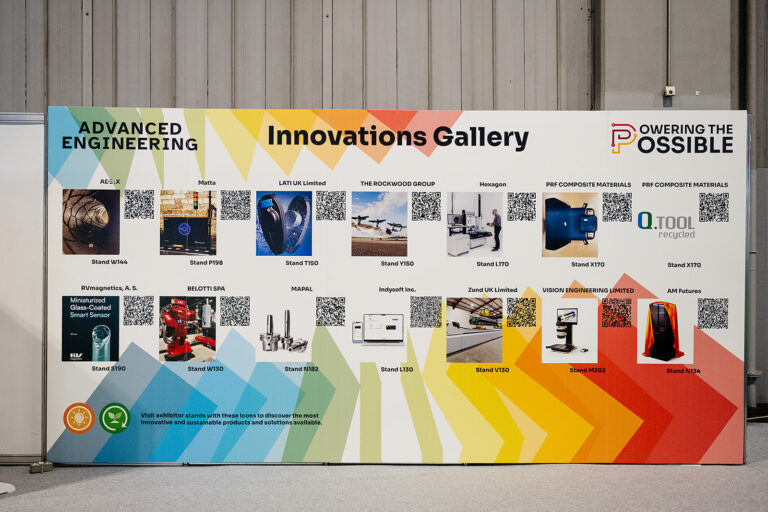
Advanced Engineering unveils its 2026 Innovation Gallery, with visitors invited to vote for the Innovation of the Year.
What do recycled aerospace metals, intelligent manufacturing systems, advanced composite materials and miniature robotics have in common? They are among the technologies selected for the Innovation Gallery at Advanced Engineering 2026, where 18 developments will demonstrate how engineers are tackling some of industry’s most persistent technical and manufacturing challenges.
Returning to the NEC Birmingham on 4 and 5 November, the Innovation Gallery will bring together technologies spanning advanced materials, additive manufacturing, automation, digitalisation, sustainability and precision engineering. This year also introduces a new element, with visitors able to vote through the official event app to select the Innovation of the Year.
The selected innovations reflect a broader shift across engineering and manufacturing. Alongside the development of new materials and technologies, companies are increasingly looking for ways to reduce production costs, improve resource efficiency, automate complex processes and bring new products into commercial use.
Rethinking Materials and Manufacturing
Several of the selected technologies address the growing importance of material efficiency and circular manufacturing.
Additive Manufacturing Solutions is showcasing developments in recycled titanium, following QinetiQ’s achievement of flying an aircraft with 3D-printed components made from recycled titanium. The development demonstrates the potential to combine additive manufacturing with material recovery in an industry where performance, traceability, and qualification are critical.
HyProMag is also addressing material circularity by manufacturing permanent magnets in the UK using recycled content. With rare-earth magnets playing an important role in electric motors and other advanced technologies, alternative approaches to recovering and reusing these materials are attracting increasing attention.
Elsewhere, PRF Composite Materials is presenting Q.tool recycled, developed to reduce labour, consumable waste and carbon usage in composite tooling, alongside its RFA570 eXpress cure adhesive film, which offers a four-minute cure at 140°C for composite core bonding applications.
L&L Products is taking a different approach to composite manufacturing through its InsituCore foaming materials. These heat-activated materials expand within a mould to produce lightweight core structures, potentially reducing the need for machining, additional bonding operations and conventional processing stages.
Together, these developments illustrate how material innovation is increasingly being driven by manufacturing efficiency as well as product performance.
Intelligence, Automation and Precision
The Innovation Gallery also reflects the continuing development of automation and digital technologies, particularly where they can help manufacturers address complex production challenges.
Matta Labs is showcasing MattaOS, a platform designed to connect intelligent software agents and provide engineers, operators and business leaders with greater visibility of manufacturing operations.
System Devices UK is presenting Mecademic’s Meca500, a compact six-axis industrial robot designed for precision automation and integration into existing equipment. Its small footprint and approach to integration demonstrate how robotics can be applied to manufacturing operations where space, accuracy and flexibility are important considerations.
Meanwhile, RVmagnetics is presenting its MicroWire Sensor technology, developed for demanding environments including cryogenic temperatures and high levels of radiation. The ultra-thin passive sensors can be embedded in composite materials, enabling monitoring of structures and components in conditions where conventional sensing technologies may be unsuitable.
Other selected innovations include Dynisma’s driver-in-the-loop motion-generation technology, Formlabs’ Fuse X1 industrial selective laser sintering ecosystem, and developments in precision laser welding, micro-coil manufacturing, and advanced material systems.
Visitors to Choose the Innovation of the Year
For 2026, Advanced Engineering is introducing a visitor vote to recognise the Innovation of the Year, giving engineering professionals attending the exhibition an opportunity to have their say on which development deserves recognition.
Visitors will be able to explore the 18 selected innovations, learn more about their applications and vote for their preferred entry through the official Advanced Engineering app.
“Innovation is often talked about in terms of breakthroughs, but what matters to industry is what those developments make possible. Whether that’s reducing manufacturing costs, recovering valuable materials, improving product performance, or automating a process that has previously been difficult to control, the technologies in this year’s gallery address some very real engineering challenges.
“We also wanted visitors to have a greater role in recognising innovation this year. The people attending Advanced Engineering understand the technical and commercial pressures facing industry, so it will be particularly interesting to see which of these developments they believe has the greatest potential.”
Connecting Innovation with Industry
The Innovation Gallery forms part of Advanced Engineering’s wider exhibition, which brings together manufacturers, technology developers, suppliers and engineering professionals from across the UK’s high-value manufacturing industries.
By showcasing developments from businesses working across different disciplines, the gallery also provides opportunities for technologies originally developed for one application to be discovered by engineers working in another.
Advanced Engineering 2026 takes place at the NEC Birmingham on 4–5 November.
 Skip to content